
Space Power and Electronic Systems
Power electronics for space: from solar arrays to power distribution, designed, built and tested at the Miguel Hernández University of Elche.
About SPES
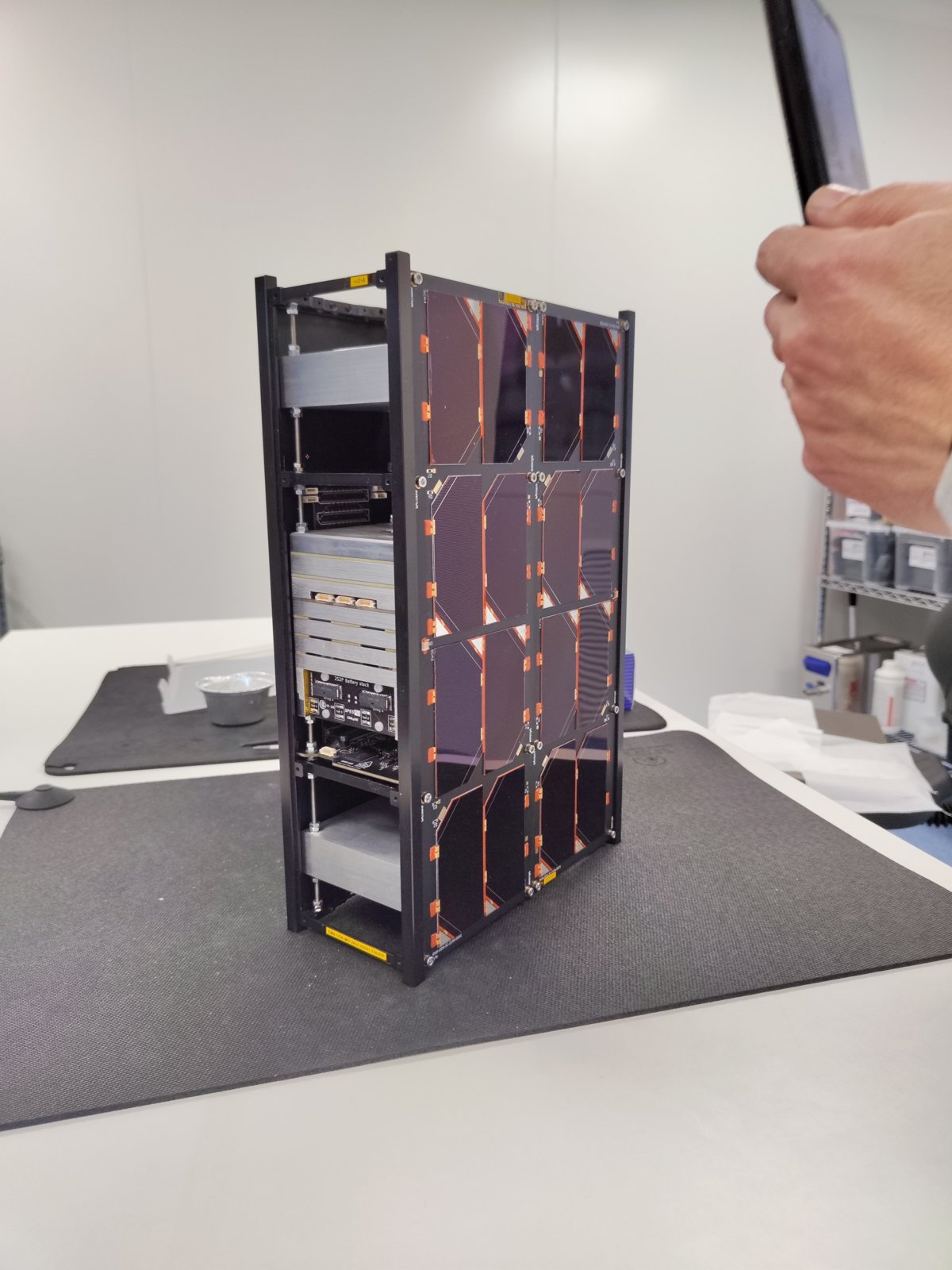
The Space Power and Electronic Systems (SPES) group belongs to the Electronic Technology Area of the Department of Materials Science, Optics and Electronic Technology at the Miguel Hernández University of Elche (UMH), Spain. For more than two decades, SPES has developed power electronics for space applications: power conditioning and distribution units (EPS/PCDU), DC/DC converters, solar array regulators, battery management, solid-state protections and wide-bandgap (SiC and GaN) power devices.
The group takes ideas from concept to validated hardware. Prototypes are designed and built in our laboratories and tested under representative space conditions, including solar array simulation, thermal vacuum, vibration and ionising radiation, together with real-time digital twins and Hardware-in-the-Loop (HIL) platforms.
20+
years in space power electronics
4
research lines
ESA
and national, regional and EU funding
2
fully equipped electronics labs
Research lines
High-reliability power conversion
DC/DC converters, solar array regulators, MPPT and redundant architectures with SiC and GaN devices.
Protection and power distribution
Latching current limiters, solid-state switches and fault-tolerant DC distribution.
Digital twins and HIL validation
Real-time models of complete EPS/PCDU systems to test control before it reaches hardware.
Reliability of COTS power electronics
Testing under radiation (TID and SEE), thermal vacuum, vibration and extreme temperatures.
From design to test
Design
Worst-case analysis, parts stress analysis and FMECA, following ECSS standards.
Implementation
PCB design, assembly and soldering in our own laboratories.
Test
Functional, thermal vacuum, radiation and vibration testing of prototypes.
Latest news
2026 · Project
SPES joins BESCAPE
Horizon Europe Marie Skłodowska-Curie Doctoral Network on advanced power electronics for space (2027–2031).
Oct 2026 · Conference
Two papers at ESPC 2026
Presented at the 14th European Space Power Conference in Estoril, Portugal.
Oct 2026 · Team
New Assistant Professor
Cristian Torres joins UMH as Assistant Professor in the SPES group.
2026 · Publication
New paper in Aerospace
“Modular and Highly Reliable COTS-Based Power Conditioning and Distribution Unit for Small Satellites”.
More news and updates on our LinkedIn page →
They have trusted us
European Space Agency · Airbus · Thales Alenia Space · Sener · Alter Technology · AAC Clyde Space · EMXYS · DHV Technology · Centro Nacional de Aceleradores · Universitat de València
Open to collaboration
We welcome industrial partners, PhD candidates and Bachelor’s and Master’s thesis students interested in space power electronics.